By RajIn Fashion14 min read
The dress shirt collar styles that cover nearly every situation are the point, spread, cutaway, button-down, tab, pin, club, wing and band collars. A good pick matches your face shape, your usual tie knot and the occasion. Choose a point collar for everyday work, a spread collar if you like bigger knots, a button-down for relaxed days, and a wing collar only when a tuxedo and bow tie are on the invitation.
The trouble is that collar names overlap. One brand's semi-spread is another brand's Kent, and a collar that flatters your friend can make your own face look longer. This guide walks through nine collars one at a time, shows what sets each apart, and tells you what to wear with it. A comparison table and a short set of rules for face, tie and occasion close the article.
ShirtsMockup makes PSD mockups for dress shirts, tuxedo shirts and suits, so collar shape is a detail we think about a lot. A collar changes how a shirt reads on screen as much as its fabric does, and that attention to detail shapes the advice below.
How dress shirt collar styles differ
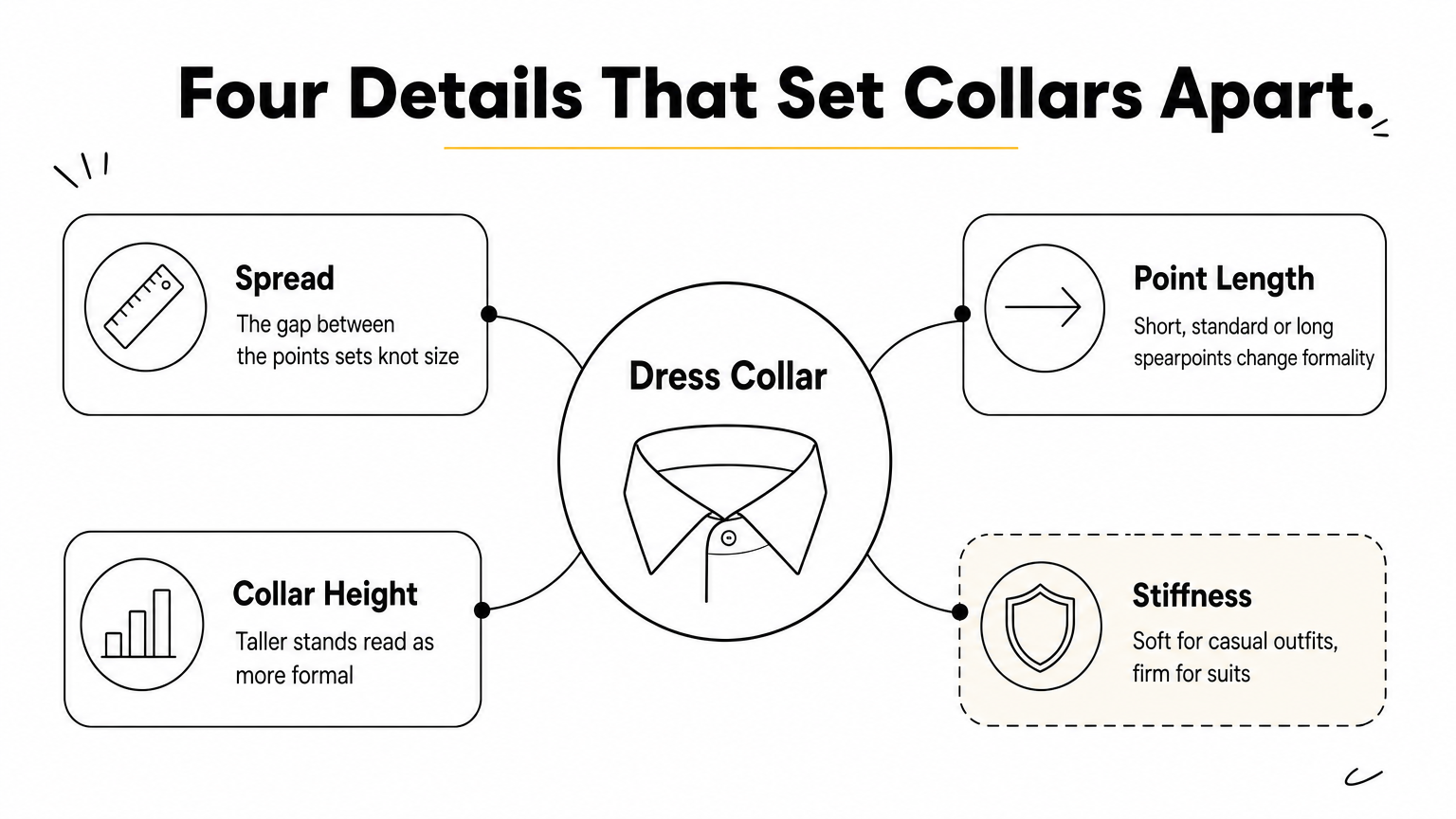
Dress shirt collar styles differ in four ways: how far apart the points sit, how long the points are, how tall the collar stands, and how stiff it is. Once you can read those four details, you can identify any collar, whatever name a brand prints on the tag.
The four details to check
Spread is the gap between the collar points, and it does most of the work. A narrow spread frames a small knot, and a wide spread makes room for a large one. Point length and collar height then decide how formal and how assertive the collar looks.
Spread: narrow, medium, wide or extreme
Point length: short, standard or long (a long point is called a spearpoint)
Height: low, standard or tall, with taller collars reading as more formal
Stiffness: soft for casual outfits, firm for suits
Spread, not the name on the tag, tells you what a collar will do.
Stiffness, stays and why the year does not matter
Stiffness comes from the interlining sewn inside the collar. Soft collars suit casual outfits and unstructured jackets, while firmer collars hold their shape under a business suit. Removable collar stays, thin strips that slide into small pockets under the points, keep point collars flat.
Collar styles also do not expire. The same shapes were on shop shelves in 2018, and what shifts from season to season is proportion, not type. Modern dress shirt collar styles lean toward moderate spreads and softer construction. Neckline is a separate topic, because it describes the opening of a garment rather than the fabric folded around it.
1. Point collar
The point collar is the default among dress shirt collar styles. It has two pointed leaves with a narrow gap between them, and it is the most common collar in the United States. If you own one dress shirt, this should be it.
What sets it apart
A point collar keeps the points close together, so only the knot shows between them. The points aim down toward the chest, which creates a vertical line that frames the face and tie. Free points curl over time, so wear collar stays and look for medium stiffness.
Also called: straight collar, classic collar
Spread: narrow
Formality: business to business casual
Best tie, face shape and occasion
Pair it with a four-in-hand or another small knot, because a wide knot would crowd the gap. The vertical lines suit round and wide faces well. Under a jacket, the points often stay visible below the lapels instead of tucking under them, which gives a clean, traditional look.
Tie: four-in-hand or similar small knot
Face shape: round or wide
Occasion: office, interviews, suits with or without a tie
The point collar is the one you buy first and never stop wearing.
2. Spread collar
Spread collars angle their points outward and leave a wide gap. It is the collar to choose when you want a fuller tie knot, and it is the most common dress collar in Europe. Among dress shirt collar styles, it is also the one that flatters the widest range of faces.
What sets it apart
Names vary here, which causes confusion. Semi-spread, Kent and English spread all describe versions of the same idea, with a wider gap than a point collar but a narrower one than a cutaway. The wider angle draws the eye outward, so the collar balances most faces. It also sits neatly under jacket lapels.
Also called: semi-spread, Kent, English spread
Spread: medium to wide
Formality: business to formal
Best tie, face shape and occasion
Use a half-Windsor or Windsor knot to fill the gap, though a four-in-hand works for a looser look. Spread collars handle thick wool or cashmere ties better than point collars do. Many men also wear them open without a tie under a jacket, as long as the collar has enough body to stand up.
Tie: half-Windsor or Windsor
Face shape: narrow or long
Occasion: meetings, weddings, cocktail events, dressy tieless looks
When you are unsure which collar to buy, buy the spread.
3. Cutaway collar
The cutaway collar is a spread collar taken to the extreme. The points sit almost horizontal across the neck, which makes it the boldest of the common dress shirt collar styles and the one that most needs a tie.
What sets it apart
Cutaway points are cut back so far that they can form a nearly straight line across the chest. The wide opening exposes a lot of tie, which is why some makers call it a Windsor collar. Extreme versions push the points back onto the neckband. The look is modern and confident, but it is unforgiving of a small knot.
Also called: wide cutaway, Windsor collar
Spread: very wide
Formality: business to formal
Best tie, face shape and occasion
Fill the opening with a large knot such as a half-Windsor or full Windsor, or the blade of the tie will show on both sides. A narrow or long face gets the most from the added width, because the collar adds horizontal balance. Wear it with a firm collar and a jacket, since a soft cutaway worn open tends to look unfinished.
Tie: half-Windsor or full Windsor
Face shape: narrow or long
Occasion: client meetings, formal events, dressy evenings
A cutaway collar makes a statement, so the knot has to answer it.
4. Button-down collar
The button-down collar fastens each point to the shirt with a small button. English polo players wore it in the 1800s to keep collars from flapping, and Brooks Brothers made it an American staple. It is the least dressy of the common dress shirt collar styles.
What sets it apart
The buttons pin the points down, and the collar is usually soft, so it forms a gentle roll around the tie knot. It is most often cut from oxford cloth. A hidden button-down uses snaps or a loop and button under the points to give the same roll without visible buttons, though the shirt front can wrinkle at the tips.
Also called: BD collar, hidden button-down (variant)
Spread: narrow to medium
Formality: casual to business casual
Best tie, face shape and occasion
Wear it with knit, wool or textured ties, or with no tie at all under a sport coat. The roll gives a tieless collar its shape, which is why it works so well open at the neck. Skip it with a tuxedo or a strict business suit, where a smooth point or spread collar looks sharper.
Tie: four-in-hand, knit or wool
Face shape: any, since the soft roll is forgiving
Occasion: casual Friday, weekends, sport coats
The button-down is the collar that still looks right with the tie off.
5. Tab collar
The tab collar has a small fabric tab under each point that fastens beneath the tie knot with a snap or button. Among dress shirt collar styles, it is one of the few built around the tie, because the tabs pull the points together and lift the knot into a neat arch.
What sets it apart
The tab sits on the inside of the collar, so the effect looks subtle from the front. It narrows the spread, props the tie up and holds everything in place all day. The look is tidy and slightly vintage. Because the tabs fasten under the knot, you cannot wear it open.
Also called: snap collar
Spread: narrow
Formality: business to formal
Best tie, face shape and occasion
Choose a slim to medium knot, since the tab leaves little room. Because it brings the points closer, it slims a wide or round face. Tab collars shine with a suit and a plain silk or wool tie. Avoid pairing them with a bulky knot or a casual jacket, where the precise look feels out of place.
Tie: four-in-hand or small half-Windsor
Face shape: wide or round
Occasion: business settings, formal dinners, weddings
A tab collar is built for a tie and looks wrong without one.
6. Pin collar
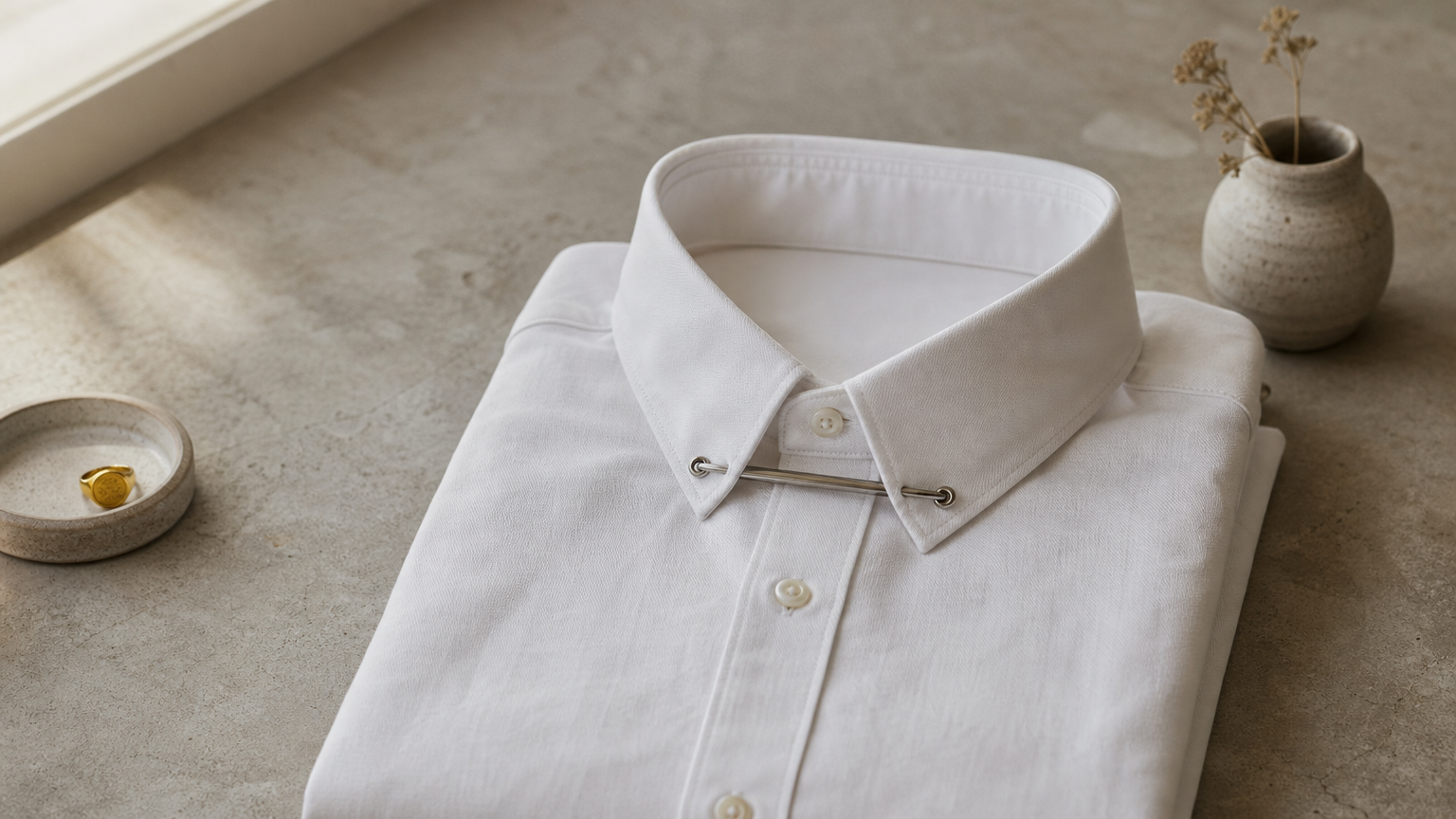
The pin collar has small eyelets in each point, and a pin or bar passes through both and sits behind the knot. Of all the dress shirt collar styles, it gives the sharpest line, because the bar holds the points close and pushes the knot up.
What sets it apart
The metal fixes the points a set distance apart, so the spread stays narrow and the tie arches out over the bar. A collar bar screws closed at one end, while a pin looks like a large safety pin. If your shirt has no eyelets, a collar clip gives a similar look without punching holes.
Also called: eyelet collar, bar collar
Spread: narrow
Formality: business to formal
Best tie, face shape and occasion
Keep the knot slim to medium so the tie arches evenly, and match the metal to your cufflinks and watch. A pin collar suits a wide or round face for the same reason a tab collar does. It is a tie-only collar and a confident one, so it works best with good tailoring.
Tie: four-in-hand or small half-Windsor
Face shape: wide or round
Occasion: formal business, weddings, evening events
A collar bar fixes what a knot alone cannot: the angle of the points.
7. Club collar
The club collar has rounded points instead of sharp ones. It is also called a penny collar, and the style is traditionally credited to Eton College, where students rounded their points to stand out. Among dress shirt collar styles, it is the softest-looking one.
What sets it apart
Rounded tips soften the whole collar. The spread is narrow, the look is vintage and preppy, and the shape is distinct enough that people notice it. A tab can be added to a club collar, because one term describes the shape of the points and the other describes the fastening.
Also called: penny collar, round collar
Spread: narrow
Formality: casual to business
Best tie, face shape and occasion
Wear it with a slim knot, or open under a blazer, since the rounded shape holds up without a tie. The curves soften an angular or square face by adding contrast to a strong jawline. A round collar pairs best with soft tailoring and notch lapels, where its gentle shape matches the jacket.
Tie: slim four-in-hand
Face shape: square or angular
Occasion: smart casual days, blazers, vintage-inspired outfits
Rounded points are a style choice, so wear them on purpose.
8. Wing collar
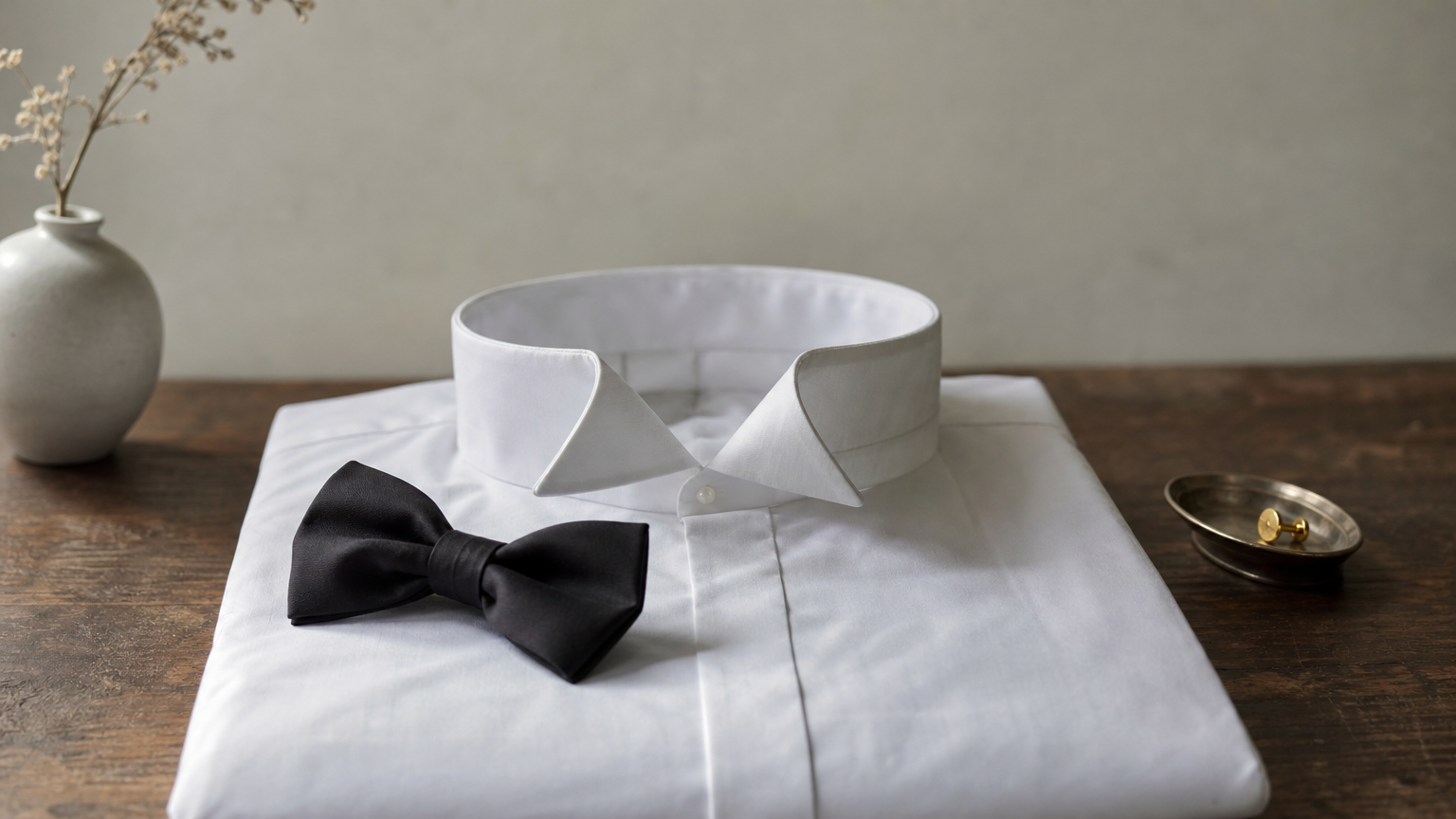
The wing collar is the formal collar. It stands up around the neck with two small tips folded outward like wings, and it is made to be worn with a bow tie. Of all the dress shirt collar styles, it is the one you wear least often and the one that matters most on the right night.
What sets it apart
A wing collar has a high stand, so it wraps the neck completely while the tips point out horizontally. It is the traditional collar for white tie and also appears on tuxedo shirts for black tie. If you design formalwear, our tuxedo shirt mockup PSDs let you preview tuxedo shirt fabrics and collar styles before production.
Also called: wingtip collar, winged collar
Spread: not applicable, the tips fold outward
Formality: black tie and white tie
Best tie, face shape and occasion
Wear it only with a bow tie, because a long necktie cannot sit properly inside the stand-up band. Men with a longer neck carry the height most easily, so try one on before you commit. For an ordinary tuxedo, a spread collar is the safer option, and the wing is a deliberate vintage choice.
Tie: bow tie only
Face shape: neutral, but check the collar height against your neck
Occasion: white tie, black tie, formal galas
Wear a wing collar when the invitation says black or white tie, and not before.
9. Band collar
The band collar has no points. It is a short strip of fabric that stands around the neck, and it replaces the tie completely. It is the most relaxed of the dress shirt collar styles, and the only one on this list that is designed to be worn tieless.
What sets it apart
Band collars usually stand about one to two inches high. The name shifts with the context: mandarin or Mao for its roots in Chinese clothing, grandad for the casual rustic version. The shape also has a history, because older shirt bodies came with a band so a separate stiff collar could be attached with studs.
Also called: mandarin, Mao, grandad, stand-up collar
Spread: none
Formality: casual to smart casual
Best tie, face shape and occasion
Wear it tieless, alone or under an unbuttoned or lightly structured jacket. Without points, it adds neither width nor length to the face, so it is a neutral choice for any face shape. It reads as modern and minimal, but it will not pass in a workplace that expects a tie and a point collar.
Tie: none
Face shape: any
Occasion: weekends, creative workplaces, layered looks under blazers
If you skip the tie, a band collar gives the neck a finished edge.
How to choose a collar by face, tie and occasion
Use three rules. Choose a spread opposite to your face width, match your knot to the gap between the points, and match the collar's formality to the dress code. Everything else is refinement.
Quick comparison
This table sets all nine collars side by side, so you can scan for the one that fits your outfit.
Collar | Formality | Tie needed? | Best knot |
|---|---|---|---|
Point | Business | Optional | Four-in-hand |
Spread | Business to formal | Optional | Half-Windsor or Windsor |
Cutaway | Business to formal | Usually | Windsor |
Button-down | Casual to business casual | Optional | Four-in-hand, knit |
Tab | Business to formal | Yes | Small to medium |
Pin | Business to formal | Yes | Small to medium |
Club | Casual to business | Optional | Slim four-in-hand |
Wing | Black tie, white tie | Bow tie only | Bow tie |
Band | Casual | No | None |
Matching a collar to your face
Collar size should echo your head size. A large head or round face can carry a bigger collar, while a tiny collar makes the face look disproportionately large. Spread works the opposite way: narrow faces take wider spreads, and wide faces take points that sit closer together.
Moderate size and moderate spread are the safest choice for daily wear. Collars at either extreme read as more rakish and less conventional, which is fine when you want that effect and a risk when you do not.
White shirts, modern looks and casual collars
White dress shirt collar styles follow the same rules, but a white shirt shows the collar's shape more clearly than a patterned one. A medium spread with a firm interlining is the white shirt that works almost everywhere. For a modern look, keep the spread moderate, the construction soft and the points neither tiny nor extra long.
Casual collared shirt styles sit outside this list. The camp collar, also called a Cuban or bowling collar, lies flat and divides in two like a notch lapel. It belongs on short-sleeve casual shirts, not under a tie.
Showing collar choices on shirt mockups
If you sell or design shirts, collar choice is part of the product image. A contrast collar in a different fabric is one of the quickest ways to make a plain shirt look designed, and it shows well in a flat or folded presentation.
The folded long sleeve dress shirt mockup offers multiple collar, cuff, pocket, placket and yoke options in one PSD. That lets you compare how a shirt reads with different collars before you commit to a sample.
Choosing the collar that fits
Start with the point collar for work, move to a spread collar when you want a bigger knot, and keep a button-down for days without a tie. Add tab, pin or club collars when you want a specific vintage detail, and save the wing collar for black or white tie. The band collar is your tieless option.
Whatever you choose, check three things before you buy: the gap between the points against your tie knot, the collar size against your face, and the collar's formality against the dress code.
If you design or sell dress shirts, show those collar choices clearly in your product images. You can try different collar and cuff fabrics on the professional dress shirt mockup PSD, which comes as five layered files and lets you hide the collar and tie when you need a cleaner view.
Comments
No comments yet. Start the conversation.