By AvikIn Fashion8 min read

Italian shirt collar styles fall into five useful types: the narrow classic Italian collar, the Italian spread (called Francese in Italy), the wide cutaway, the high-band collar, and the soft unfused collar. Choose the narrow classic if you have a round face and wear slim ties. Choose the spread if you want one collar that works everywhere, and the cutaway if you wear thick tie knots or have a narrow face. The high band suits a long neck, and the soft collar suits relaxed, open-neck wear.
The trouble is that the names do not line up. One maker's Italian collar has tips almost touching, while another's has points set wide, and some brands label that same wide shape French. You can easily buy the wrong shirt without realizing it.
This guide describes each style by what you can see and measure, says who it suits, and explains how to wear it. It also shows where the Italian and French labels overlap. We make PSD dress shirt mockups at ShirtsMockup.
1. Classic Italian collar with close points
The classic Italian collar is the narrow, long-pointed shape. It is the most traditional of the Italian shirt collar styles and the one most people picture when they hear the name.

What it looks like
The collar has long, elongated points set close together, leaving only a small gap for the tie knot. Among classic collars it is the narrowest, and it reads as sharp and slightly formal.
Labels vary, though. Some makers call a wider, more open collar "Italian," and others call that same shape "French." Judge by measurements, not the name: ask for the point length and the distance between the tips.
A collar's name tells you less than its point spacing does.
Who it suits
A narrow collar works best on round or fuller faces, because the close points and long lines add vertical length. It is less kind to a long, narrow face, which it can make look longer.
It also suits men who wear slim lapels and fitted jackets. The proportions match, so the shirt looks deliberate rather than borrowed.
How to wear it
Pair it with a small four-in-hand knot and a slim tie. The knot fills the narrow gap, while a bulky knot pushes the points apart and spoils the shape.
Always use collar stays. Without them the long points curl upward, especially under a jacket.
2. Italian spread collar, the Francese
The Italian spread collar is a moderately wide collar whose points angle away from each other. In Italy it is known as the Francese, which is why English-speaking brands often call the same shape a French or spread collar.
What it looks like
The points sit farther apart than on the classic Italian collar, so the knot has room and the collar frames it. A rough guide is about 3.25 to 4 inches between the points, though makers vary. Many spread collars are fused for rigidity, which keeps the points crisp and flat.
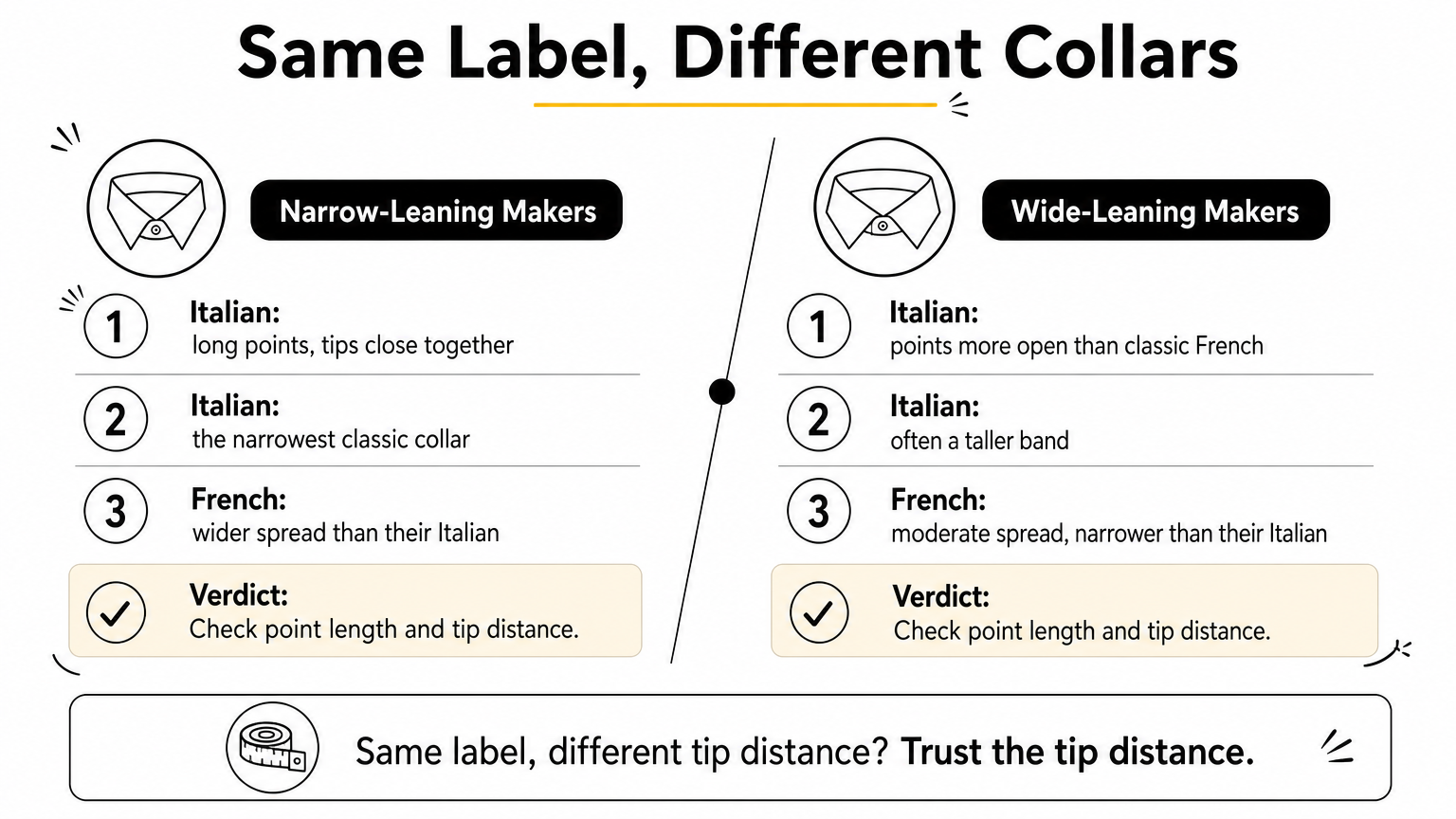
Here is how the labels commonly overlap:
Label | Narrow-leaning makers | Wide-leaning makers |
|---|---|---|
Italian collar | Long points, tips close together, the narrowest classic collar | Points more open than a classic French collar, often a taller band |
French collar | Wider spread than their Italian collar | Moderate spread, narrower than their Italian collar |
Safe check | Point length and tip distance | Point length and tip distance |
If two collars carry the same label but different tip distances, trust the tip distance.
Who it suits
Almost everyone. Of all Italian shirt collar styles, it is the best first one to own because it balances most face shapes, and it is especially flattering on longer, narrower faces that a narrow collar would stretch further.
It also works across body types, so if you only buy one style from this list, make it this one.
How to wear it
Wear it with a half-Windsor knot, or a Windsor if the tie is thin silk. It also holds its shape open at the neck, and the stiffness keeps it from collapsing.
Under a jacket with medium lapels it looks balanced. It is the safest choice for interviews, weddings, and office days.
3. Wide cutaway Italian collar
The wide cutaway is the most open Italian collar, with points cut back almost horizontally. It is the dramatic option and the clearest contrast with the narrow classic.
What it looks like
The points are set very wide, and the gap between them is large. Some makers call it an extreme spread. It highlights the face and gives the shirt a distinct presence, which makes it the boldest of the Italian shirt collar styles in tailoring.
Because so much of the tie shows, the knot becomes part of the look. A flat or sloppy knot is obvious here.
A cutaway collar turns the tie knot into the main feature of the outfit.
Who it suits
It flatters long or narrow faces by adding width at the neckline. On a round face it can look overly broad, so try a spread collar instead.
It also suits men who like confident, fashion-forward tailoring and wear wider lapels, such as a peak lapel jacket.
How to wear it
Use a thick knot, such as a full Windsor, in a substantial tie. A thin knot looks lost in the space.
Choose a collar with firm construction and stays. A limp cutaway droops, and the points lose the clean line that makes the style work.
4. High-band Italian collar
The high-band collar has a taller collar band than a standard shirt, often paired with an elongated spread. Among Italian shirt collar styles, it is the one that changes most how the shirt looks at the neck.
What it looks like
The band stands noticeably higher around the neck, and some shirts use two collar buttons to support the extra height. The points are usually long, and the spread is often a little wider than a classic collar's.
The result is a tall, structured neckline that looks formal when buttoned and deliberate when open.
The height of the band, not the shape of the points, defines this collar.
Who it suits
It works best on men with average to longer necks. A tall band fills the space between jaw and shoulders and adds a polished frame.
If you have a short neck, a high band can swallow it. A lower-band spread collar is the better choice.
How to wear it
Wear it buttoned to the top with a tie, and choose a knot that sits comfortably above the second button. A slightly larger knot keeps the proportions right.
Open at the neck, the high band stands up and looks stylish, as long as the collar is stiff enough to hold. Check that the first button closes without pinching.
5. Soft unfused Italian collar
The soft collar is about construction rather than shape. It uses little or no fusing, so it rolls and drapes naturally, which is the relaxed side of Italian shirt collar styles.
What it looks like
The collar has a gentle roll and no stiff, flat edge. It can still be a narrow, spread, or cutaway shape, but it softens whichever you choose. Over a day it settles and moves with you, whereas a fused collar stays crisp.
That softness is the opposite of the crisp, fused finish you see on some spread collars.
Pick the collar shape first, then decide how stiff you want it.
Who it suits
It suits casual and smart-casual wearers, travelers, and anyone who dislikes a rigid neckline. It is a natural choice for linen and light cotton shirts.
It is less suited to strict business dress, where a crisp collar under a tie is expected.
How to wear it
Wear it open at the neck with an unstructured jacket or on its own. A tie works with a soft collar, but the points will roll and the look turns relaxed rather than sharp.
Skip the stays if the shirt is designed without them, and let the collar do its own thing.
Picking the collar that fits
Choose the narrow classic for slim proportions and small knots, the spread for an all-round collar, the cutaway for thick knots and long faces, the high band for long necks, and the soft collar for casual days. Compare tip distance and band height rather than trusting the label.

If you design or sell shirts, the same detail matters on screen. The Professional Dress Shirt Mockup comes as five layered PSD files at $17, with an option to set different fabrics on the collar and cuffs. Check its product page for the collar shapes included before you build your shirt presentation.
Comments
No comments yet. Start the conversation.