By Tojo8 min read
The men's shirt collar styles history spans about 700 years. Collars began as a plain neckband on a linen undershirt in the 1300s. They grew into ruffs and lace in the 1500s and 1600s, then lost ground to the cravat. In the 1820s they became detachable, and in the early 1900s they were sewn back onto the shirt. Each change followed the same few forces: religion, wealth, class, and laundry.
This article walks through that timeline in order. You will see why collar history matters, how collars developed before 1800, how the detachable collar produced most of today's shapes, and how to use all of it when you choose or design a shirt.
ShirtsMockup makes Photoshop mockups of dress shirts and tuxedo shirts, so collar shape is something we think about daily. A collar changes how a whole garment reads, and that has been true for centuries.
Why the history of men's shirt collars matters
Collar history matters because the collar is the part of a shirt people see first, and for centuries it announced who you were. Knowing the story helps you read old portraits, decode the names in a shirt catalog, and pick a collar on purpose instead of by habit.
The collar was a status marker before it was a style
Early on, the shirt was an undergarment, and the collar was the only visible piece of it. That made it a signal of cleanliness and money. A starched, laced, or detachable collar told people you could afford laundry, or the servants to do it. A crisp, bright band near the face showed at a glance that the wearer changed his linen often, which few people could claim. In the 1800s the same logic split office workers from laborers.
Every major collar change in history traces back to class, religion, or laundry.
The history explains the names you see today
Many collar terms are fossils of an earlier era. Once you know where they come from, product descriptions and style guides become much easier to read. A few examples:
- White collar and blue collar: from the starched white detachable collars of 19th-century office workers.
- Wing collar: the stiff formal collar of the late 1800s, now mostly seen on tuxedo shirts.
- Band collar: a direct descendant of the earliest shirt collars of the 1300s.
- Button-down: a sporting collar from the 1890s that became everyday wear.
How collars grew from a neckband to a cravat
Men's shirt collars began as simple neckbands in the later 1300s and, by 1800, had passed through ruffs, lace, and the cravat. This early stretch of men's shirt collar styles history is mostly a story about status, because the collar was the one part of the shirt that anyone could see.
Band collars and the first ruffs
Shirts of the later 1300s gained a simple band collar, and by the mid-1400s standing collars appeared on both shirts and undershirts. Because the shirt sat beneath heavier layers, that strip of white linen was all anyone saw. Churchmen wore it first, as a sign of humility and purity, and the nobility then turned it into fashion.
In the early 1500s the collar was raised along the neck and gathered, which produced a small ruff. Around the 1530s the edges folded down again. Courtiers soon favored full ruffs, while tradesmen, scholars, lawyers, and Protestants kept the flatter collar. Shape had started to signal profession and faith.
Lace, falling collars, and the cravat
In the 1600s the flat collar became a luxury item. Falling collars trimmed with lace spread over the shoulders, most dramatically at the French court of Louis XIII. Protestant Northern Europe kept collars smaller and plainer. Nobles and newly rich merchants competed in lace, and the collar became a banner of rank. Some were so elaborate that they were made separately from the shirt.
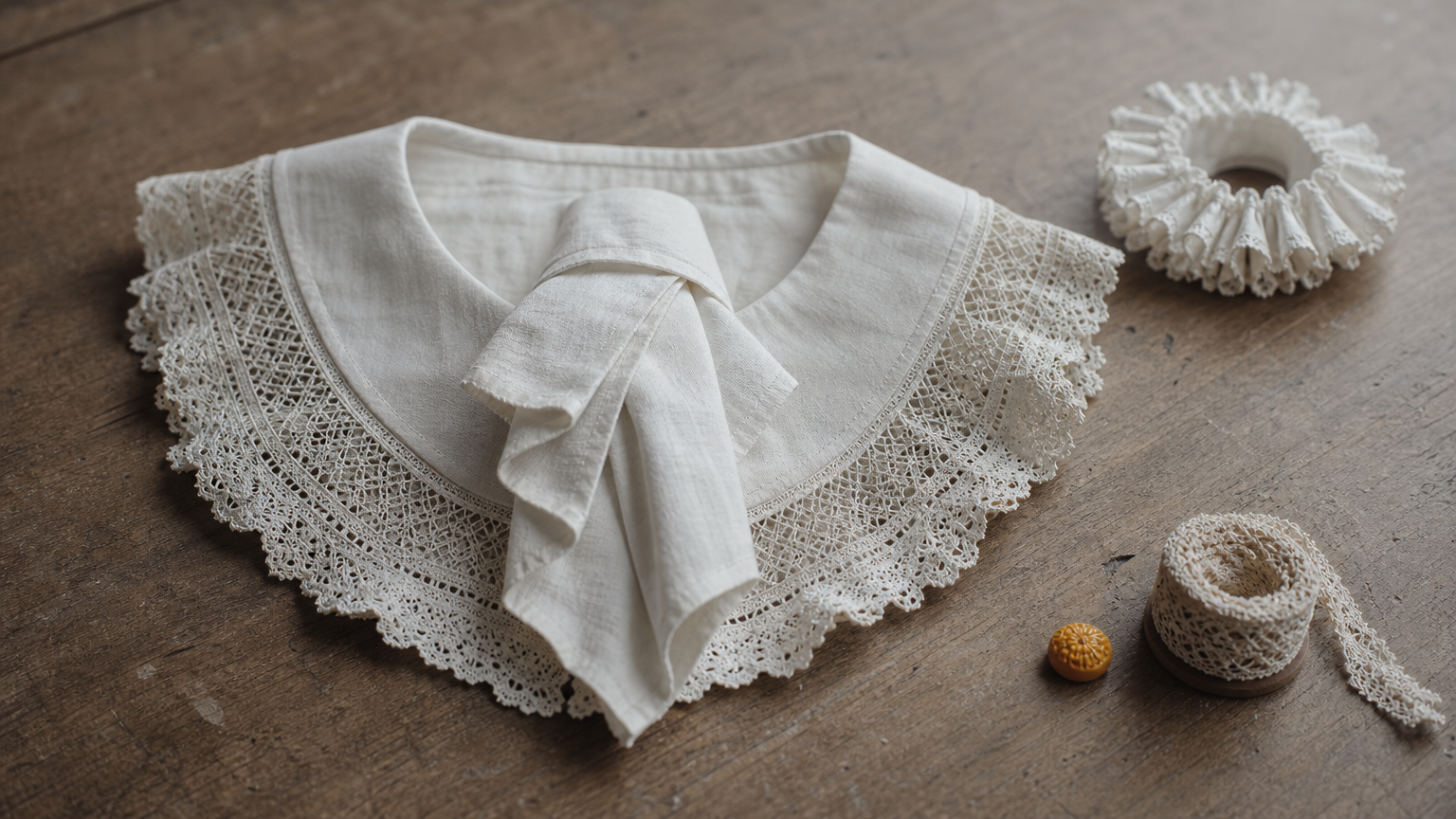
By the late 1600s the cravat, introduced through Croatian mercenaries serving French kings, began replacing turn-down collars. Flat collars survived mainly on churchmen, magistrates, and ministers. Through the 1700s the shirt neckline stayed plain and was closed with a strip of cloth, and by about 1760 stand collars were returning on jackets.
By 1800 the collar had been a ruff, a lace shawl, and a hidden band, and it was about to be detached.
How detachable collars created the modern shapes
The modern collar took shape in the 1800s, when a laundry shortcut turned into a whole field of design. Most of the men's shirt collar styles history after 1800 is the story of one separate piece of cloth and the tailors who kept reshaping it.
The detachable collar and the white-collar worker
According to the usual account, Hannah Lord Montague of Troy, New York, noticed in the 1820s that dirt gathered at her husband's collars. She cut them off and added a buttonhole and button so that only the collar needed washing. Within a few years, Troy manufacturers were mass-producing detachable collars. British and American tailors then codified new shapes, and most of the collars we know today were invented between 1880 and 1910.
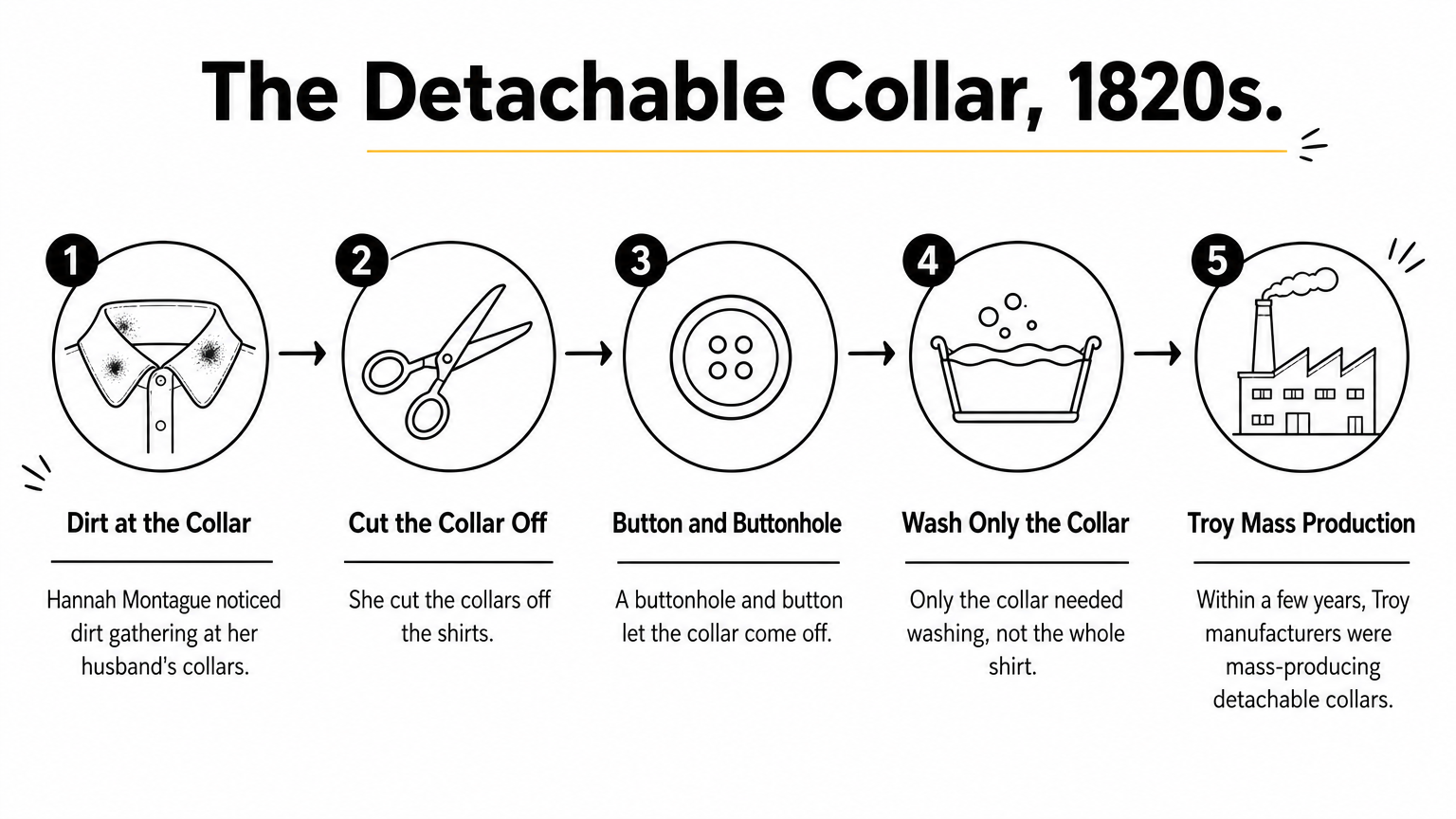
Detachable collars were starched, white, and obvious, so they became a symbol of office work, which is where "white collar" comes from. Early in the 20th century the collar was sewn back onto the shirt body, and the styles above simply moved with it.
The detachable collar did not just save laundry. It gave tailors a separate canvas to design.
Collar styles by era
Here is how the best-known shapes line up, with approximate periods.
| Collar | Rough period | Origin and meaning |
|---|---|---|
| Stand-up (officer) collar | 1800s | Found on 19th-century military uniforms, now a casual-elegant band look |
| Wing collar | Late 1800s to early 1900s | Stiff formal collar, today mostly on tuxedo shirts |
| Button-down | 1890s | Attributed to Brooks Brothers, inspired by English polo players |
| Spearpoint (Barrymore) | 1920s | Long narrow points of about 3 inches, the trendiest shape by 1928 |
| Spread collar | 1930s onward | Wide gap for larger tie knots, often linked to the Duke of Windsor |
| Dagger collar | 1970s | Oversized long points that matched the wide lapels of the decade |
If you are wondering what 1970s collars were called, "dagger" and long-point collars are the usual answers.
Read the table as a record of problems that each shape solved. The wing collar gave formal dress a stiff, crisp frame under the chin. The button-down pinned its points to the shirt so they stayed put during sport. The spread collar opened the neckline so a thicker tie knot had room. Spearpoints and daggers did the opposite and drew the eye down the chest with long, narrow points. Dates are approximate and shapes overlapped for decades, so treat each row as the era when the style was most visible, not the year it began.
How to use collar history when you choose or design a shirt
Knowing men's shirt collar styles history makes this choice easier. Choose a collar by the job its ancestors did: formal collars for formal events, spread and point collars for business, and softer collars for casual wear.
Match the collar to the occasion
Each shape still carries the mood of its era. A wing collar reads as black tie, a spread collar pairs with a tie and a wider knot, and a button-down or band collar reads relaxed. Retro shapes such as the spearpoint or dagger work best as deliberate period statements. Use this quick guide:
- Black tie: wing collar or a classic turn-down.
- Business with a tie: spread collar for wider knots, point collar for a narrower look.
- Casual or smart casual: button-down, or a band collar worn open.
-
-
Period looks: spearpoint for the 1920s, dagger for the 1970s.
Your tie and face shape also count. A narrow point collar suits a slim knot and a rounder face, while a spread collar gives a wider knot room and balances a longer face. When in doubt, match the collar to the formality of the event first, then adjust for the tie. The same logic applies to design work: pick the era you want to reference, then choose the collar that carries it.
-
Show collar options before you commit
If you design or sell shirts, test collar and fabric combinations before production. The Professional Dress Shirt Mockup ($17) comes as five layered PSD files and lets you put a different fabric on the collar and cuffs. A white contrast collar on a striped shirt echoes the detachable-collar look. For formal collections, the Tuxedo Shirt Mockup ($27) shows tuxedo shirts in layered PSD form. Check each product page for the collar options included.

Collar history gives you the vocabulary, and a mockup lets you test it on your own fabric.
The collar's story in short
The collar began as a hidden neckband, became a ruff and a lace shawl, lost ground to the cravat, and was detached for the wash. It then returned to the shirt in the shapes we wear now. Class, faith, and laundry drove almost every step.
You can use that story as a practical guide. Match formal shapes to formal occasions, choose spreads and points for the office, and keep button-downs and bands for casual days. If you design shirts yourself, try the Professional Dress Shirt Mockup to preview collar and cuff fabrics before you cut any cloth.
Comments
No comments yet. Start the conversation.