By RajIn Fashion12 min read
The main tuxedo shirt styles are the plain (fly) front, the pleated front, the piqué bib front, the plissé front and the wing collar shirt. Black or colored shirts round out the list for creative dress codes. Pick by formality. A plain front suits you if you want a modern look and one shirt that does everything. A pleated front suits a classic black-tie wedding. A piqué bib with a wing collar suits you if the invitation says white tie, or if you want the most traditional look possible.
The trouble is that formal shirts all look white and similar on a hanger. The front, collar, cuffs and fabric change how formal a shirt reads, and the wrong combination makes a tuxedo look like office wear. This article explains what a tuxedo shirt is and what it is called, walks through six styles one by one, and covers the collars, cuffs, studs and fabrics that finish the look.
ShirtsMockup makes PSD mockups of tuxedos, dress shirts and other formalwear, so these construction details matter to us for a practical reason: they decide whether a shirt looks right in a product photo. If you are buying a shirt, you get a clear guide. If you are designing or selling one, you get the vocabulary.
What a tuxedo shirt is and what it is called
What makes it different from a dress shirt
A tuxedo shirt is a formal white shirt built to be worn with a tuxedo. It differs from a regular dress shirt in its front, collar and cuffs. You get a bib or a smooth covered placket instead of a plain button strip, a wing collar or a clean spread collar, and French cuffs for cufflinks. It also has no chest pocket, which is one reason an office shirt looks wrong under a dinner jacket.
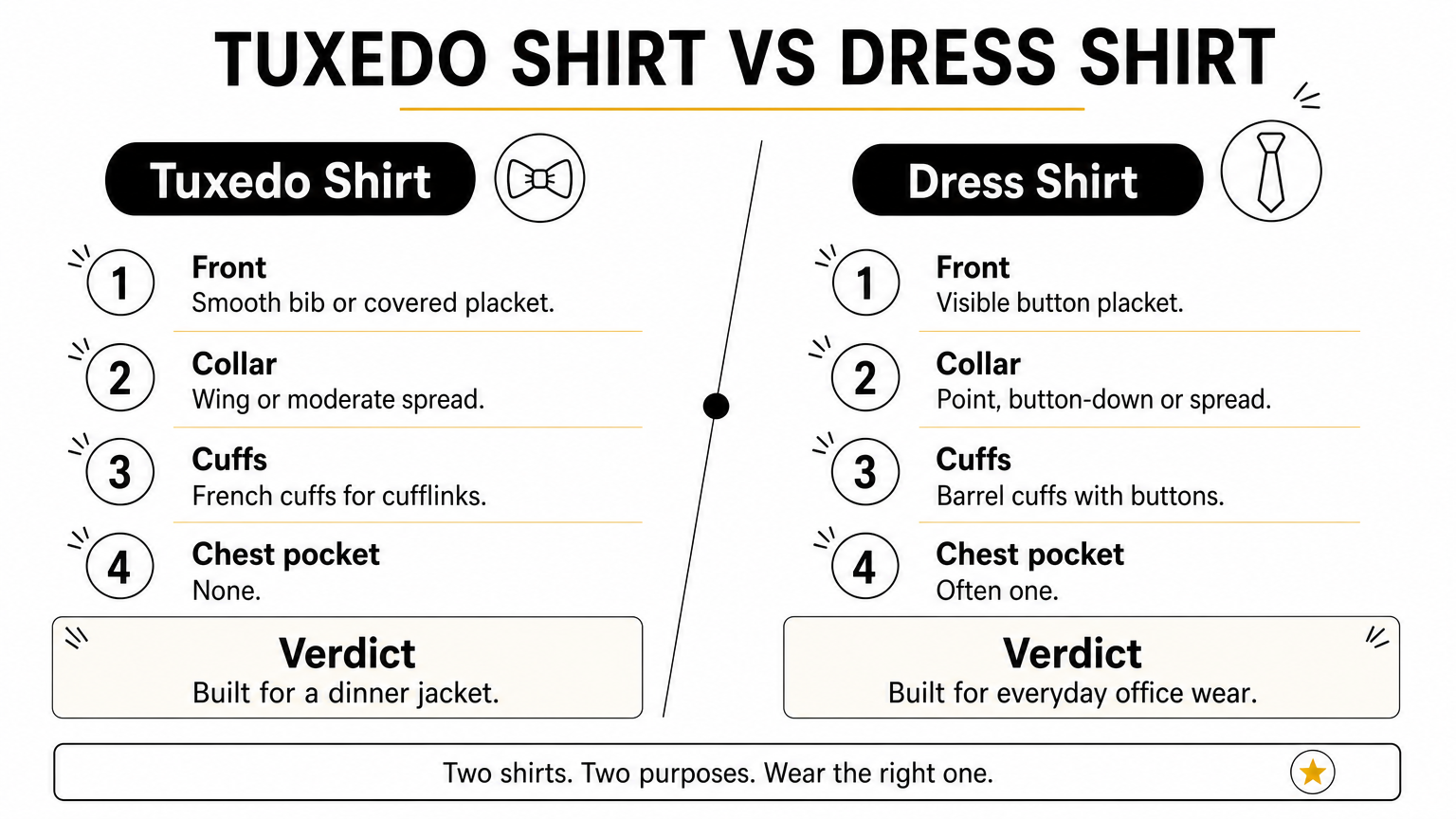
Detail | Tuxedo shirt | Regular dress shirt |
|---|---|---|
Front | Bib (piqué, pleated, plissé) or smooth covered placket | Standard placket with visible buttons |
Closure | Studs through eyelets, or hidden buttons | Sewn-on buttons |
Collar | Wing collar or a moderate spread, no collar buttons | Point, button-down or spread |
Cuffs | French cuffs with cufflinks | Barrel cuffs with buttons |
Chest pocket | None | Often one |
Color | White is the standard | Any |
A tuxedo shirt is defined as much by what it leaves out (pocket, visible buttons, barrel cuffs) as by what it adds.
What a tuxedo shirt is called
You will see several names for the same garment. Formal shirt, evening shirt and black-tie shirt all mean a tuxedo shirt, and some stores say "tuxedo dress shirt." In the US, "dress shirt" on its own means the everyday button-up, so add "tuxedo" or "formal" when you shop. A few terms come up constantly:
Bib: the front panel of the shirt, which can be piqué, pleated or plissé.
Studs: removable fasteners that replace buttons and pass through eyelets in the front.
Fly front (covered placket): a strip of fabric that hides the buttons for a smooth front.
French cuff: a double cuff folded back and closed with a cufflink.
Wing collar: a standing collar whose tips fold down and sit clear of a bow tie.
The six styles at a glance
Use the table as a quick map before you read the detail. All six are formal, and the differences are about degree. Formality here is relative, and the dress code on your invitation always has the final word.
Style | Formality | Usual collar | Closure | Best with |
|---|---|---|---|---|
Plain (fly) front | Moderate, modern | Spread | Hidden buttons | Dinner jacket, slim lapels, bow tie or long tie |
Pleated front | Moderate | Spread or turndown | Studs or buttons | Notch or shawl lapel, velvet jacket |
Piqué bib front | High | Wing or spread | Studs | Peak or shawl lapel, white tie |
Plissé front | Moderate to high | Turndown | Studs or buttons | Three-piece tuxedo or cummerbund |
Wing collar shirt | Highest | Wing | Studs | Peak lapel, waistcoat, bow tie |
Black or colored shirt | Creative only | Turndown or spread | Varies | Events that allow it |
1. Plain front (fly front) tuxedo shirt
What defines it
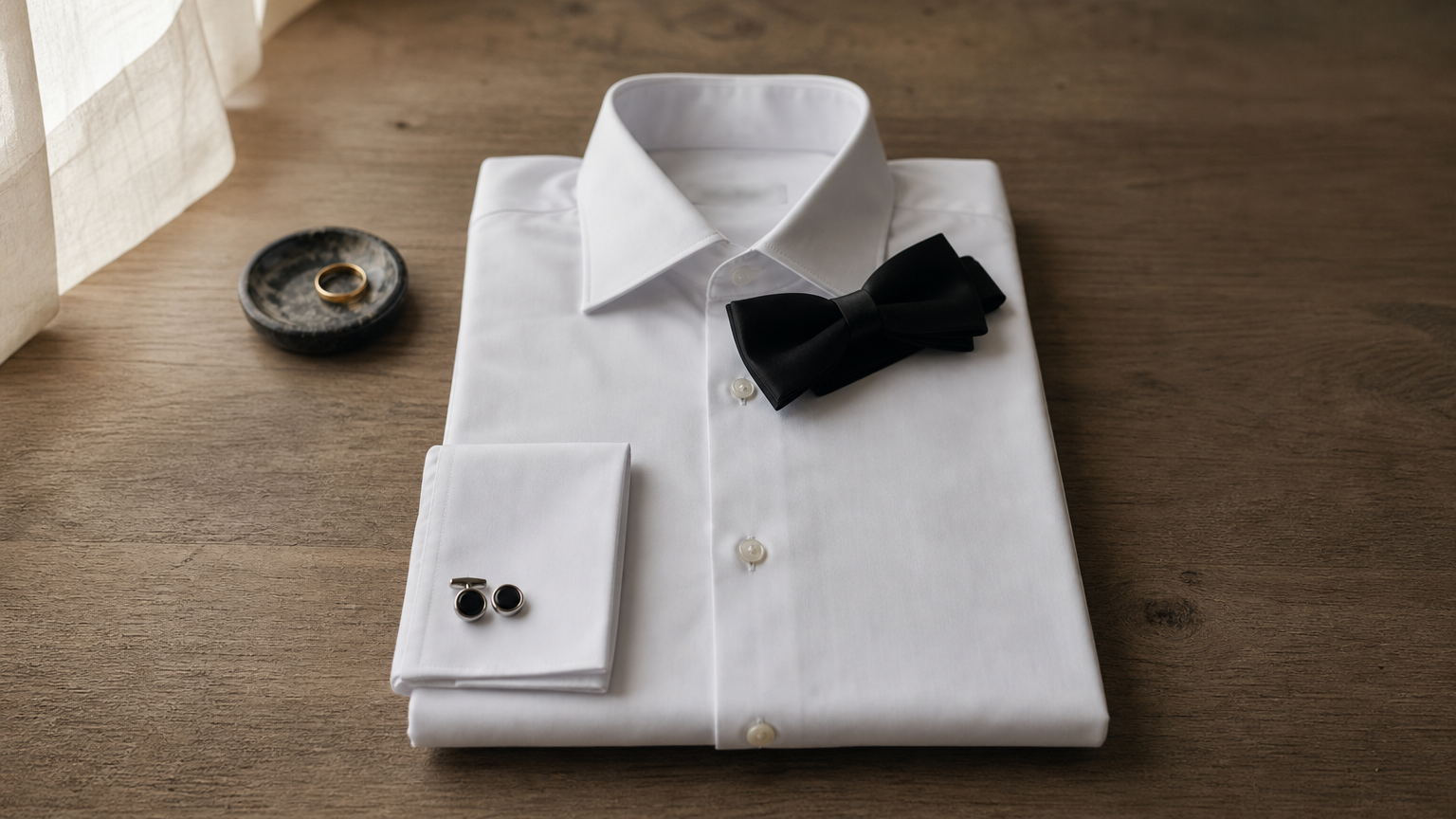
The plain front is the cleanest of the tuxedo shirt styles. The button strip hides behind a fold of fabric, so the front is one smooth panel with no pleats, no bib and no studs. Some versions add a removable button strip, so you can swap buttons for studs when you wear a tuxedo.
Smooth front with a covered placket
Usually a spread collar and French cuffs
Reads as modern rather than traditional
Works with a bow tie or a long black tie
Who it suits and what to pair it with
This is the best first tuxedo shirt. It sits on the less formal end of the range, so it looks natural with a dinner jacket, a notch lapel or a slim-lapel tuxedo. It is also the only style that works comfortably with a straight tie, and in a pinch it can go under a regular suit.
The catch is pressing. With no texture to hide creases, a plain front needs to be ironed or steamed well, and the wrinkles show in photos. Choose it if you want one versatile shirt, a contemporary look, or a shirt that will not fight a relaxed jacket.
The plain front is the safest single tuxedo shirt to own.
2. Pleated front tuxedo shirt
What defines it
A pleated front has narrow vertical folds running down the chest. The classic pleat is about half an inch wide, which looks traditional without turning busy. Most pleated shirts pair the bib with a turndown or spread collar, a stud or button front and French cuffs.
Vertical pleats across the bib
Turndown or spread collar
Stud front or buttons
French cuffs
Who it suits and what to pair it with
Pleats are distinctive but conservative. They are a touch less formal than a piqué bib, so they work with a shawl collar or notch lapel jacket, a double-breasted tuxedo, or a velvet or textured dinner jacket. Skip the straight tie. A pleated front is a bow tie shirt.
Match pleat width to your frame. Narrow pleats flatter a slim build, and wider pleats suit a broader chest. If the shirt is cut too tight, pleats can pull and gape across the chest. Pick this style if you want a classic black-tie look with some character.
Match the pleat width to your build, and the pleated front looks deliberate instead of busy.
3. Piqué bib front tuxedo shirt
What defines it
Piqué is a cotton weave with a raised, waffle-like texture, and on a bib front it gives a stiff, crisp panel against the smooth rest of the shirt. The bib lies flat under the jacket, and piqué resists creasing. This is the most formal of the common front styles. A close cousin is the self-textured shirt, woven from one fabric with a tone-on-tone texture and a stud front, which sits just below it.
Textured piqué bib, smooth body
Stud front
Wing or spread collar
French cuffs
Who it suits and what to pair it with
Wear a piqué bib with a peak or shawl lapel jacket, a good set of studs and French cuffs. It is the standard answer for white tie and the strongest choice for a strict black-tie ceremony or gala. If the invitation is formal and you do not want to second-guess it, this is the shirt.
Ask your cleaner for a light press, not heavy starch. Over-starched piqué turns shiny and stiff like cardboard, which loses the texture you paid for. It suits traditionalists, formal weddings and anyone attending white tie.
When the dress code is strict, a piqué bib is the shirt nobody can question.
4. Plissé front tuxedo shirt
What defines it
Plissé is a fabric with fine, closely spaced pleats that create soft vertical lines down the front. The pleating is finer and shallower than a classic pleated bib, so the front reads as a subtle texture rather than a row of folds. The style has a European feel and is usually paired with a turndown collar.
Fine, close pleating across the front
Turndown collar
Studs or buttons
French cuffs
Who it suits and what to pair it with
Plissé looks best under a three-piece tuxedo or with a cummerbund, where the waist covering gives the front a finished frame. It is a weaker choice if you plan to wear a dinner jacket with no waistcoat or cummerbund, so pick another style in that case.
It suits men who want texture without the rigidity of a piqué bib. If your look leans toward Italian or continental tailoring, a soft plissé front fits the mood better than a heavy bib. Check the pleating with the shirt on, because fine pleats show every pull across the chest.
Plissé gives you texture without the stiffness of a bib.
5. Wing collar tuxedo shirt
What defines it
The wing collar is the most formal collar there is. It is a standing band with small points folded down, so the tips sit clear of the bow tie instead of closing over it. A wing collar shirt almost always comes with a bib front, studs and French cuffs, and the bow tie sits fully visible below the wings.
Standing collar with folded tips
Bib front (usually piqué)
Studs and French cuffs
Bow tie only, never a long tie
Who it suits and what to pair it with
Purists reserve the wing collar for white tie, and it is the correct collar there. Plenty of men also wear it for traditional black tie, where it looks old-school and elegant. It pairs best with a peak lapel, a waistcoat and a black bow tie. Skip it for relaxed or semi-formal settings, where it looks costume-like.
Fit matters more here than anywhere else. A collar that is too loose droops, and one that is too tight makes the top stud uncomfortable by dessert. Choose it if your event is white tie, a formal gala, or a wedding with a strict evening dress code.
The wing collar is a white tie requirement and an optional flourish for black tie.
6. Black or colored tuxedo shirt
What defines it
A black or colored tuxedo shirt keeps the formal construction, such as French cuffs and a clean front, but swaps white for another color. White is the standard because it creates the sharpest contrast against a black jacket and frames your face in photos. A black shirt under a black tuxedo flattens that contrast, which is why many style guides advise against it.
Same formal construction, different color
Black, ivory, cream or deeper shades
Often a turndown or spread collar
Rarely right for traditional events
Who it suits and what to pair it with
Wear a black shirt only when the dress code allows it, such as a creative black-tie or fashion-forward evening event. An all-black look in velvet or midnight tones can work if you commit to it fully. Ivory is a narrow exception, best under an ivory or cream dinner jacket, where it looks intentional rather than dingy.
If you are unsure what the invitation means, wear white. It is never wrong, and a misread dress code costs far more than a missed chance to stand out. This style suits performers, creative events and confident dressers who have checked the rules.
When in doubt, wear white. A misread dress code costs more than a safe shirt does.
Collars, cuffs, studs and fabrics that finish the shirt
Collar choices beyond the wing
Outside the wing collar, a moderate spread collar is the best all-round choice for a tuxedo shirt. It frames a bow tie properly and also handles a long tie on a plain front. Turndown collars are a bit more relaxed and show up on pleated and plissé shirts.
Stay away from button-down and ordinary point collars. The little collar buttons belong to sportswear, and a standard point collar looks like it came from the office. Whatever you pick, the shirt collar should show about a quarter inch above the jacket collar, and you should be able to slip one or two fingers between collar and neck.
Cuffs and studs
Formal events call for French cuffs. Square and rounded French cuffs are equally formal, so choose by taste. Save barrel cuffs for business shirts. The cuff should extend a quarter to a half inch beyond the jacket sleeve, and the links should be simple and kept as a matched set with your studs.
For studs, black onyx and mother of pearl are the standard. Onyx is the most timeless and versatile. Wipe studs after wearing and store them in a pouch so they do not scratch each other.
French cuffs and a plain set of studs matter more than any single bib choice.
Fabrics that work
Stick to white cotton. It breathes, presses sharply and looks richer than a polyester blend, which tends to trap heat and shine under flash. The weave then sets the character of the shirt.
Fabric | Look and feel | Best for |
|---|---|---|
Twill | Opaque, slight shine, drapes well under a jacket | The most formal plain or bib fronts |
Broadcloth | Smooth, modern, a little more sheer | Contemporary plain fronts |
Piqué | Raised, crisp texture | Bib fronts |
Royal Oxford, jacquard | Visible woven texture | Textured looks with a stud front |
Twill and broadcloth are the two safest choices for a first shirt. If you are choosing for a long wedding day, pack two shirts, such as a self-textured one and a fly front, so you can change before the dancing starts.
Presenting these details in a design
If you design or sell tuxedo shirts, the details above are what a customer looks at first: the bib, the collar, the cuff and the fabric. A product image has to show them clearly, which is why a mockup with separate layers and a fabric Smart Object saves so much time. You swap in a twill, a piqué or a jacquard and see the result at once.
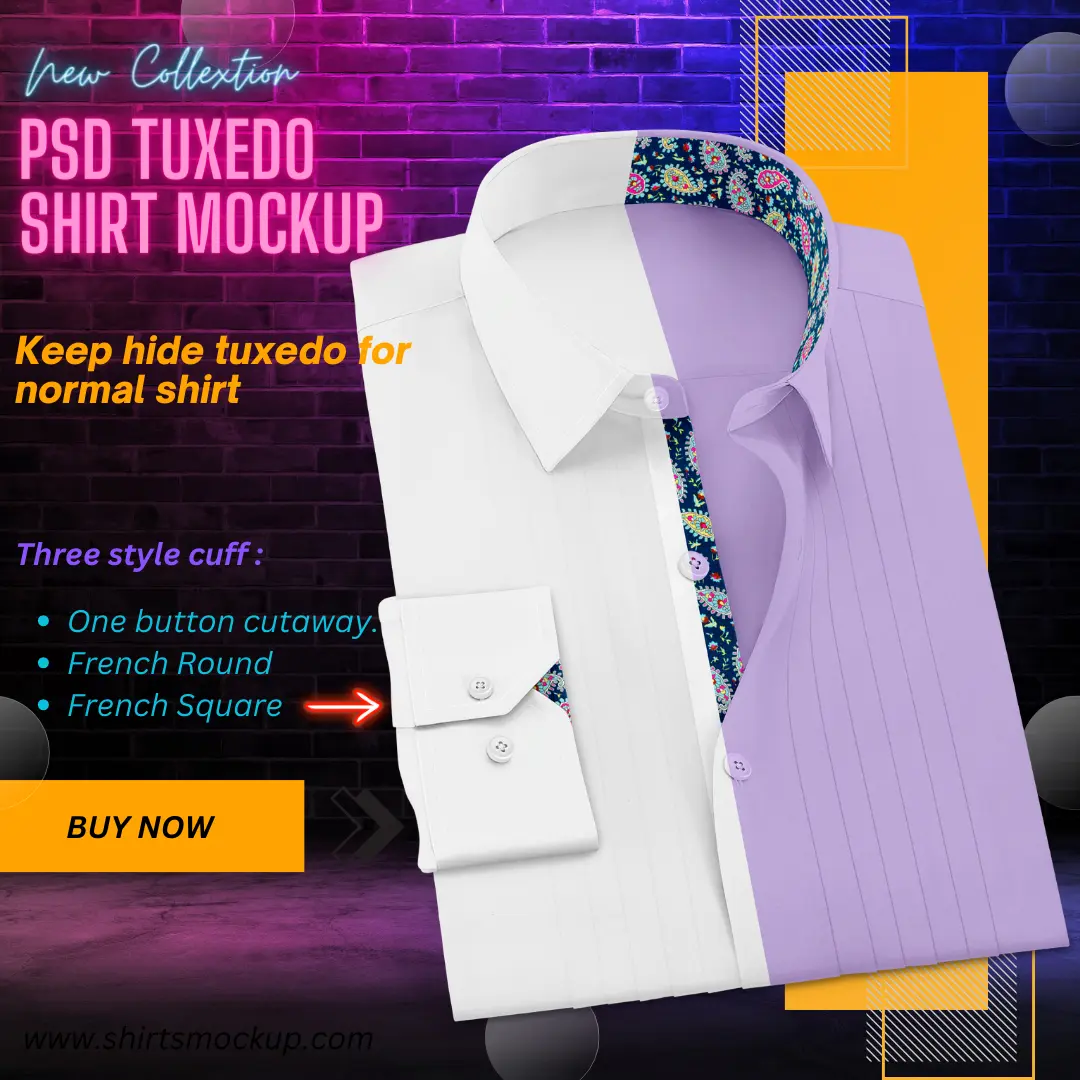
ShirtsMockup's Tuxedo Shirt Mockup comes as three layered PSD files at 3500 x 3500 px, and you replace the fabric by double-clicking the Smart Object. It is built for designers previewing tuxedo shirt fabrics and collar styles, with no photo shoot needed.
Choosing your shirt
The best of the tuxedo shirt styles is the one that matches your jacket and your dress code. Go plain front for a modern, versatile shirt. Go pleated or plissé for texture and tradition. Go piqué bib with a wing collar when the evening is strict, and keep black or colored shirts for events that clearly allow them. French cuffs, studs and 100% cotton apply to all of them.
If you design or sell formalwear and want to show these shirts at their best, you can preview your own fabrics on the Tuxedo Shirt Mockup before you produce a single shirt.
Comments
No comments yet. Start the conversation.